Saturday, December 24, 2011

Lepakshi... A Photo blog.

(Click on the Photographs to see them in detail.)


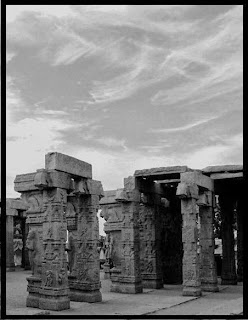
The Kalyanamantapam - wide west view.


                        Magnificient mural on the Natyamantapam ceiling


The west side decorative pillars.


                                                                                                 Lord Shiva in a dance pose.  


Natyamantapam with '70' pillars with Lord Shiva and Rambha seen between the pillars.

An ancient way of showing things in 'fast forward' mode!


                                                                    Another colourful mural on the ceiling.
                                                                           The south side pillars with beautiful carvings near the Large Ganesha idol.


The incomplete Kalyanamantapam with the delicate stupas.
With my darlings... Anitha and Mitha near the huge monolithic Nandhi.
                                                                                   
(Click on the Photographs to see them in detail.)
All Photos (C) Dr Manjunath Byadigere 2011.
More info @
en.wikipedia.org/wiki/Lepakshi

Saturday, December 3, 2011

AN EYE OPENING EXPERIENCE

The consciousness that self discovery through service to larger than self can be a deeply satisfying experience was brought home to me recently in the most unexpected manner.

This is also a story about how the unintended consequences of an action are often greater than the intended ones.
[Photograph of Health Camp organised and conducted by me in my native village Byadigere (AP-Karnataka border about 20kms north of Madhugiri town, Tumkur Dist) on the 18th of April 2009]

Some of you know that I am part of Team Canadia (and its associate NGOs Project Kandwar and The Eighteenth Horse Foundation). We are a group of professionals in Bangalore attempting to give a hand up to the needy in the Greater Chikballapur Area (GCA). The five active members of this group conceived and executed a General Health Camp in Kandavara that is Ward 14 of the City Municipal Council of Chikballapur. The Camp was conducted on 2011 October 16, Sunday, on the premises of the Heritage Primary School where Sir M Visveshvaraya had studied.
.
The Episode

As you can guess, I reached out to the network of physicians and secured the help of most volunteer practitioners. When I called my friends my intention was straightforward. To simply provide much needed professional health service to the poorest of the poor. That, I am happy to report, was achieved, thanks to the tremendous assistance provided by all my friends. What I did not expect was how one patient would touch me in such a deeply moving fashion.

A 30 year old lady came to me with a large swelling in her neck. The area of the swelling was approximately 6 cms x 6 cms. It was easy to diagnose that she was suffering from a thyroid malfunction. I knew that a careful follow up would mitigate the problem and probably cure her of her condition. Routinely I requested her to come and see me at my base, namely, Victoria Hospital in Bagalore.

The lady came to Victoria. After some preliminary investigations we came to know that the swelling was (much to my relief) benign, a colloid cyst and her thyroid function was normal. With the permission of my unit chief and my senior colleagues I admitted her and on 2011 November 24, Thursday, I conducted the surgery. It was a 90 minute procedure and the surgery went well. On Monday, the 28th, we discharged her. She expressed grateful thanks to me and the others in Victoria and left.

The Unintended Consequence

What happened to me next has propelled me to write this story in the hope that other health professionals will undertake voluntary work and experience the same awakening that I have experienced. I am still absorbing the revelation.

After discharging the patient I went for the usual walk on campus. It happened so suddenly that I had to stop, literally, to sense the extreme bliss of calm that coursed through me. It was a sense of deep satisfaction that came from doing my job, assisting a patient, receiving her thanks, and reflecting on that sequence.

I come from a typical lower middle class family primarily based in agriculture for generations. Whatever my family and I have achieved thus far is the result of sheer hard work, daringness and luck. And I completely understand that luck might not have accompanied everybody always.

By sheer accident I had met the patient. It is very likely that she and her family have not had the good fortune that my family and I have had. From her point of view, the economic and social distance separating the two of us is probably unbridgeable in her lifetime. And yet, we connected at the deepest level of human fraternity.

Forgive my dramatic formulation when I say there are no words to describe the affinity I felt for her while I was removing the malignant tissues from her neck. Was it the awareness of my good fortune to be able to help an otherwise helpless person? Was it meant to be as some wisdom literature tells us? Was it simply doing the job that is expected of me by the people and the Government of Karnataka? I do not know.

What I do know, however, is that I was in a state of serenity that I have never been. That serenity has enabled me to learn a little about what drives me in my belief in serving something larger than self.

It is my firm conviction that all of us are endowed with the gift to give of ourselves to a cause that we believe in.

Wednesday, July 13, 2011

Mein, meri biwi aur... woh!

I wake up sharp at 6am and get ready quickly.

6.40, I’m outside the house with my camera as I wait for Anitha (my wife). It’s time for our usual morning walk. She comes out leisurely. After a short time of walking she complains that I’m too fast. I slow down trying to hide my impatient excitement! Anitha is talking something but my mind is elsewhere.

I remember the day, five days ago when I first saw her during our morning walk. I had noticed her beauty accidentally when she had come close to us. And what a beauty she was! She looked great in yellow and brown, with some green sprinkled here and there.

We had reached the spot where I usually find her. With no clue of her whereabouts I look around. She is not to be seen anywhere. I’m now walking slowly. Anitha turns towards me suspiciously. Looking at some tiny lavender flowers I say ‘Ah... why don’t you walk for sometime in the football ground as I try to focus these flowers in the manual mode’. She gives an expression that says ‘somethings-fishy-here’! Luckily for me she walks on.
While I try focusing my lens on the flowers I keep my ears vigilant for her seductive sounds! I look at my watch, 7.20; she has to be here soon! I’m becoming increasingly impatient.

Just when the flowers are in focus, Anitha who has come up right behind me for some unknown reason shrieks ‘Wow... what a beauty she is..!!’, even Anitha is smitten by her beauty! I hush Anitha as I focus my camera on the beauty.....

Check her out here...

http://www.youtube.com/watch?v=R__cVW3s9R4
(cut and paste the link to a new window)

Monday, June 6, 2011

INNOCENT FACES!

ELATION!

CONTEMPLATION!

BLISS!

SUSPICION!


SOMNOLENT!


EXASPERATION!

ASTONISHMENT!

CONTENTMENT!

(All photos copyright Dr Manjunath Byadigere, 2011)

Thursday, March 31, 2011

An Ode to the Rain Tree

A few days ago when Anitha (my wife) and I were on our usual post-dinner walk our discussion turned towards the nearby rain tree. She noticed the tree and said something was different in it at night. I told her that the tree was sleeping as the leaves were folded. We stood under the tree and gazed at the canopy for sometime wondering at its animal like behaviour. Looking at the bright fluorescent street light close to the tree she asked me how could the tree sleep with the bright light so close by. This question made me think as I didn’t know the answer but raised some more questions in my head. Are we doing any justice to the tree for all the things the tree is giving us? We are shamelessly utilising the many benefits of the tree and not even allowing the tree to sleep peacefully at night!

I see you every morning,
Wholesomely green with not a chink,
With your leaves shining,
And with your blanketed canopy pink.

To find you feeding the parakeets,
With your ripened sweet pods,
And the bees buzzing on your flowers,
For your sweet nectar in florid pots!

I wonder at the glow,
Your flowers show,
Echoing the sun’s rays,
To lift my mood in many ways!

Am in awe looking down,
To see your shell like pod,
With the seeds in line as if sown,
Flattened and adhered to the road.

I wonder if I can make a ball,
Like I made them in my childhood years,
With the thick gooey pulp,
Of those dark ripened fruits of yours.

[Video link http://www.youtube.com/watch?v=6HwR5ZE99RA ]

In the golden dust of your dead flowers,
I stand shielding myself from the callous sun,
And seeing the scorched flowers tumbling down the air,
Ah! Yes, they remind me of my granny’s hair!

I gather as the sun goes down you fall asleep,
With the darkness your leaves fold in a clap,
But I wonder where at night will you go,
With all the city bright and aglow?!

Thursday, February 24, 2011

'Devaru'... The God. A short story.

This short story is dedicated to all the Postgraduates in all the specialities of Medicine.

This story is completely fictional. All the characters and situations are entirely fictional and do not carry any medical sense nor legal significance, and have been created only for the purpose of this story. Any resemblance is purely coincidental.

[Prologue:- This story is about the doctors who are NOT gods but humans. Human beings with all the characters, sentiments, feelings, emotions, beliefs and idiosyncrasies like the rest of us. This story is not just about the protagonist, or his mother or the intern but also about his junior, ‘Trauma’, and also the assistant to the obstetrician who are all human and doctors... but not gods.]

‘Hi Sir’ she smiles at me with her dimples showing off as she whizzes past me holding a lab sheet in her hand. I feel a breath of fresh air for a moment and feel relaxed forgetting the fact that I was working nonstop for eighteen hours and getting grilled by ‘Trauma’ in the OT. ‘Hello...’ I reply, but she’s gone already past me into the emergency lab. Well, what the hell... I still had two days to ask her out before she completed her internship postings in my unit. Every time I saw her she disturbed my thought processes. I now try and concentrate on the call I was given by my junior as I rush down to the Casualty from the OT.

The patient is almost breathing heavily as I can hear him at the emergency room door. My junior, a thin, tall, spectacled Bagalkot guy rattles off before I even reach the bedside ‘Eighteen year old male, RTA two hours ago, pillion rider, driver dead, pulse one twenty and going up, BP sixty by forty and dropping rapidly ....now not recordable, tachypnaeic, GCS fourteen, CVS and RS clear, no external injuries other than a bruise right chest, abdomen tap nil, fluids started with green needles ...’ ‘Heart, chest sounds?’ ‘Clear ree sara, nodeenree’ (Its clear Sir, I’ve seen it) but he hands me the steth. The patient is now restless and throwing his arms around. I try and listen to his heart in the emergency room with all the noise around. Multiple sounds ... from the surroundings, ‘whoooosh’ his left lung goes and with a slightly duller right side. I take out the steth and watch his chest. The ribs showing in his emaciated chest... the gap between the ribs on right side more than the left side..... ‘Large bore needles’ I call out ‘It’s a pneumothorax’, I quickly stab in two IV fluid cannula’s at the second (ICS Inter costal space) with the false hope of removing the air in his lungs as the nurses hold the boys limbs ... and as my junior searches for a large bore needle in the metal cupboard. Luckily I remember the blade in my pocket... I take out one and stab between the cannulae .... ‘aahhh’ the guy cries in agony as he experiences pain without any anaesthesia .... I take out my metal Jetter pen; take off the refill and stab the sheath in with all my weight... the muscles give way as I hear the soft whistle of escaping air...

I wipe away sweat from my forehead and foggy glasses and blood from my hands as I notice a middle aged man beside the bed in his torn shirt covering his mouth with a dirtied towel... and staring at me with bewildered eyes. My junior runs back to me ‘Saraa, large bore ...’
-----------------------%------------------------
I look at my mobile. 3:22am. ‘Vrrrrrrr...’ the vibrations in silent mode makes me almost drop the Android. ‘Trauma calling...’ Well, Trauma was my very sadistic very senior staff member. He was interested in trauma cases and derived extreme sadistic pleasure from traumatizing us with his trauma related patient management and questions. ‘Yes, Sir ....’ I’m now more humble than it sounds. ‘Yes Sir, coming Sir...’ The bloody quack wanted to do a quick rounds at this hour and so I run to the wards.

She’s there, in front of Trauma, both showing off their teeth and smiling at each other for some f**king silly reason I assume. His face turns ominous as he sees me; she acts serious as if she has not noticed me. He looks down at the patient and with his deep gurgling voice thunders ‘Ahh..., eega araam iddira?’ (How are you now?), the patient is almost in stupor and sleepy but manages to mumble ‘parvaagilla saar’ (not bad sir), ‘Passed flatus?’, before I realise that the question was directed at me Trauma asks ‘I’m not asking the patient if you have passed flatus’, She giggles. His face is shone as if he has won a battle. ‘Sir, he is taking orally ...’ He realises his mistake of misrecognition now ‘Ahhh... he is the intestinal obstruction patient, right?’ ‘Yes sir, the operated blunt trauma patient is on the other side...’ ‘Yes, of course, but the exams are fast approaching and you guys still have no wind of when patients break wind, ehh’ He chuckles at his own joke and she, somewhat strangely continues with her giggles.

Racing down to follow-up another patient at Casualty I curse Trauma immensely and request divine intervention in sending him back to his wife at Delhi or even to his getting-aborted-twice-a-year unmarried daughter who was ‘studying’ in the US of A. Trauma, as I understand him, he himself must be under a lot of trauma at present!

Oops! My Android! I remember keeping my mobile beside the Obstruction patient’s bedside... I rush back in haste. Just as I’m passing in front of the Duty doctor’s room I notice I’m attracted to something sounding familiar. I slow down in front of the dark room and listen to the familiar deep gurgling voice, paradoxically which is something like a whisper now. As I wonder with whom Trauma was talking at this hour I hear the attractive giggles, muffled at the same time!
-----------------------%------------------------
I walk in silence to the patient’s bedside; pick my Android which looks as if it was lying there orphaned. My assumption had come true. The whole world seemed as if motionless and insignificant now. Unknowingly I’m in my duty room tired... and almost deceived, gazing at my mobile pointlessly. And I don’t know why, at four in the morning and after forty days I remember her for the first time. I call my mom.

I hear a woman howling as my mother’s voice breaks in ‘One minute Putta...’ Yes, she still called me ‘Putta’. I wait as the howling gets intense and as my mother requests her assistant ‘...will you please continue with the delivery, I need to take this...’ a voice answers sincerely ‘No problem, ma’am’ ‘Yeah, call me if there is anything... I will be just outside’. As a practicing Obstetrician she was deliberate with her processes. I hear her ripping off her gloves as she comes back on ‘Studies chennagi nedeetha iddya putta?’ (How is your studies going Putta?)Is she worried about my studies more than me! ‘Huu... nedeetha ide.’ (It’s going on) I answer more vaguely. I hear her breathing softly now.

Silence.

More silence follows as I don’t know what to talk. ‘Avalu siglilva...?’ (You didn’t get her, right) ‘Aaa...’ I’m speechless, ‘hmmm... aa intern thane? Avaligintha olle hudugi sigthale bidu ninage... You are worth more than that girl. She didn’t deserve you!’ Again, I don’t know why but some tears rolled down my cheeks as my voice was caught in my throat. In the background the howling had stopped and I could now hear the first cry of the baby.

Forty days ago I had made a passing comment about my intern, and that’s it, now she knew the whole story! As I found it difficult to breath I quickly managed to utter ‘Will call you later mom’ and cut the call... and I broke down.
-----------------------%------------------------
I wait for some time to get ‘stabilised’ and wash my face before coming out of my room to see what my junior has done with the newly admitted patients. As soon as I come out I notice the middle aged man with the torn shirt sitting directly in front of the room on haunches. His eyes look sunken and bright at the same time now. He gets up seeing me. As I turn towards the Casualty he almost leaps to my feet to hold them together. I wait. He is now in tears as I feel the drops of warmth on my socks. He stutters between sobs ‘Devaru saar neevu, Devaru neev nange...’ (You are my god Sir) I hold him by his shoulders to lift him up. As he gazes at me and wipes his tears with his dirtied towel I slowly walk away from him to inspect a freshly wheeled-in young lady who is burnt from head to toe.

Sunday, January 23, 2011

'Shop Class as Soulcraft' by Matthew B. Crawford. A book Review.


Most of us at the end of our work days may find something amiss amidst the chaos which surrounds our works. The pleasure we get in our routine may only be restricted to the weekends and not to our workdays. Are we being carried away by the abstractions of life much hyped in the so called information and creative economy? What importance are we giving to the works of the electrician or the mechanic and what lessons have we learnt from them? The phony advantages of the white collar jobs are easily exposed in this work of Crawford.

Matthew Crawford quotes from philosophers, sociologists and psychologists and from some interesting studies and experiments to drive home the view of what we understand about the manual trades (blue collar works) is utterly specious. He makes us understand the ‘abstractions’ in which we are buried deep with relation to the contemporary ‘knowledge work’ (white collar jobs). His philosophy digs deep into the deliberation processes associated with an individual, the job he does and the community he lives in. He deals with the idiotic suppression of the manual trades and the similar amplification in status of the clerical cubicle jobs. He gives us an understanding about our jobs in particular and about our lives at large. Once we get into the flow of understanding his views and ideas the book transforms itself into an interesting enlightening source drawing inspirations from our own daily life situations.

The author is also deeply concerned towards students and is worried about the dispositions we are trying to instil in young minds. He tells us not to treat students as ‘brains in a jar’ and tells us to cultivate knowledge instead of trying to produce credentials in the learner. His book shows us the value of real knowledge and how it needs to be procured.

Two very important questions on which the book is about are
1. What advice should one give to a young person with regard to education, college and job?
2. Why a career in manual trades should be given equal importance to pursue?

Outwardly the book may seem as if to dwell ONLY with the manual trades and their superiority with relation to the cubicle jobs. Of course, the book is a strong case presented in support of the manual trades, but what for?, ultimately the pattern of jobs are discussed in detail to give the students a clearer picture of what awaits them and their choices. The final conclusions to be drawn refer only to these two queries. Crawford answers these questions by digging into the sustaining reasons behind his own personal life and also by explaining the events why thinking and doing are the same and need not/cannot be separated, why man desires to be the master of his own stuff, why there are a lot of contradictions for the cubicle professional life, how a manual trade requires thinking as good as doing and finally how pleasurable a trade can get akin to leisure or work with full engagement.

Crawford’s philosophy leads us into a thoughtful finale regarding what advice a youth can be given regarding education and what is a college for. If the student is capable of sitting in the school for 17 years and wants academic achievements to pursue his dream job (ex:- if the persons aim is to become a teacher/professor {in India} maybe an M.A or B.Ed is required, if he wants to do research maybe a further three years of schooling is required after his graduation), he has to go through the schooling processes, no doubt there is no argument regarding this. But if a student wants to become a mechanic or an electrician there is no need for him to endure further schooling after 10th or 10+2 for he can attend a short course in his desired field and then attain expertise by gathering skill and knowledge by experience. There is no need for higher education in this case and this will definitely work for him.

What if the same person who wants to become a mechanic is pushed into college and higher education? At the end of his collegiate education (which he goes through in frustration) the person may be further compelled to sit in a cubicle all throughout his life (which he goes through in frustrated frustration) as now he has a degree to carry and live up to! Maybe he will wear a clean white shirt and a matching tie and join a BPO or something similar and earn less than a mechanic too!

Crawford argues that our society has created a trail for every individual to pursue without considering individual preferences. Universal knowledge and choices overrule individual knowledge and predilections. The society we live in has created a false world with ‘abstractions’ in which somebody daring and positive is treated as an unconventional eccentric. Crawford rightly calls his book a ‘cultural polemic’ and starts from our education system and annihilates the myths our society has towards what is called a good education.

Crawford also argues that in sharp contrast with the blue collar worker’s job the knowledge worker’s cubicle job at the end of the day is filled ‘with layers of abstractions’ as the knowledge worker doesn’t know if his work for the day was of any use to others, he had nothing to do with authority nor command but only with obedience to rules and regulations, he doesn’t have a community to associate his work with, he doesn’t know the character/personality of his consumers he is dealing with, he cannot discuss or encourage individual preferences as they are treated as obstacles to progress of the ‘team’, if ever there is a peer group he doesn’t get any regards from his peers as his own expertise is unrecognised, respect in a cubicle is for indebted discipline and not for individual sovereignty, remuneration he gets paid is for toiling to do somebody else’s work and not for cultivating his own passions, he is more concerned with results and profits than how it is achieved, focus is on getting things done and labour cost with no importance given to the larger gestalt, he lives in a narcissistic utopian world where creativity and innovation are just ‘unleashed’ potentials from ‘bizarre mavericks’ rather than mastery of a work through long practice, he works in a setup where ‘extraordinary human ingenuity’ is ‘being used to eliminate the need for human ingenuity’, where idiocy and the capability to do nothing are treated as a idyllic virtue, etc., etc. The list is endless.

The author also deals in detail why the manual trades are seen as low prestige jobs, simply because they are dirty and because of the false assumption that they are stupid. And if the important question is to earn a living why are talented and poor students forced through the routines of higher education to end up in earning academic credentials which in turn lead to a cubicle job, which is in all ways an advanced stupidity! The job may be white collared but not without neck deep dissatisfaction filled with ‘layers of abstractions’.

Strongly but rightly, Crawford diverges from the ‘middle class discipline’ to disapprove of encouraging college and higher education as a further extension of schooling. As discussed, Crawford worries about the talented and creative students who are not willing to sit in a school for 17 years and later on end up in cubicle jobs to sit there for all their lives. (In the Indian scenario sadly, a large group of students may not be able to go through their schooling simply because of their economic status). He wants the youth and their parents to bury the unintelligent attitude shown towards the blue collar jobs and embrace them to find true satisfaction in their professions.

Crawford quotes from Marge Piercy’s poem “To Be of Use,” which concludes with the lines “the pitcher longs for water to carry/and a person for work that is real.” This passage struck me the most. At the end of the day’s work what will you answer if somebody asks you, what have you accomplished today? The ‘knowledge worker’s answer will be nonspecific, vague and obscure unlike the mechanics ‘the car is now running’ or the electricians ‘and there is light’. The manual traders work is there for everyone to see, feel, utilise and experience. Aren’t the works of manual trades real? By this Crawford precisely identifies what was amiss among our work lives, the aptitude in a human ‘to be of use’ to other humans.

A hard to put down book concerned with the essence of job and life, wonderfully researched and executed to drive home a disregarded fundamental point.